


AI Agent Threat Response and Data Leakage Control Solution
SOMANSA Privacy-i AIDR is designed to respond to next-generation threats arising from AI agents.
By combining traditional EDR endpoint threat detection and response with DLP and AIDR protection for AI agent interactions,
it provides security visibility and a response framework for new business environments, from employee PCs to generative AI.
Privacy-i AIDR is Korea’s first AI agent security solution to proactively adopt the latest security technologies.
No. 1 in Endpoint DLP Market Share for 20 Years, Proactively Developed AI Agent Security by SOMANSA
Control AI Agent Misuse and Autonomous Execution Threats
Korea’s First AI Agent Security Solution
Developed by SOMANSA, a data protection specialist ranked No. 1 in DLP market share for 20 years
and trusted by more than 1,000 customers.
Privacy-i AIDR detects and responds to autonomous AI agent execution, external service connections, and data exfiltration risks to provide security controls for AI-enabled work environments.

20 Years
Endpoint Security
Expertise

40+
40+ Generative AI
Services Controlled

3 Areas
3 AI Usage Areas Controlled
Integrated AI Security
From Harmful Website Blocking to AI Agent Security
SOMANSA has expanded its security controls as AI usage environments have evolved.

PHASE 01
Secure Web Gateway
Blocks malware distribution, harmful, and non-business websites

PHASE 02
WebKeeper AI DLP
Blocks and controls leakage of personal data (patterns) and confidential data (keywords) through generative AI

PHASE 03
LLM Gateway
LLM-Based Semantic Analysis and Context Understanding

PHASE 04
AI Agent Security
AI agent threat response and data leakage control, including misuse and autonomous execution
Generative AI Services and AI Agents Require Different Controls.
From web-based generative AI services to AI agents running on endpoints,
apply the right controls for each environment to minimize AI security blind spots.

Privacy-i AIDR
EndPoint
Control AI agent execution and usage behavior
Control local LLM and MCP server usage
Control offline and isolated network environments
Block unauthorized AI models and execution tools

WebKeeper AI DLP
Network
Control AI service usage on unmanaged endpoints
Control server-to-server external LLM communications
High-performance content analysis including OCR and document similarity
Apply network policies to new AI services centrally
CORE STRENGTHS
With Korea’s broadest AI coverage, from AI agents to MCP servers,
centrally control all AI usage across the organization.
The number of AI assets used within organizations is growing rapidly.
Privacy-i AIDR automatically identifies AI agents, AI services, and MCP servers
and helps manage them securely with policies by user, department, and purpose.
TARGETS
Control Targets

AI Agent
Control internal and external AI agents

AI Service
Control generative AI services

MCP Server
Control external tool calls
ENVIRONMENTS
Execution Environments

Desktop App
PC-installed AI

Browser / SaaS
Web-based environment

IDEㆍCLIㆍWSL
Developer environment
USE CASES
Granular Data Transfer Control

By User, AI Agent, AI Service, and Model
Control transmitted data with granular policies.
Allow services, models, and data appropriate for business purposes
- Specify approved services by user and department
- Allow text transmission while restricting sensitive data
Restrict usage that violates security policy
- Block unauthorized services and discontinued models
- Restrict external MCP server calls and sensitive data transmission
KEY FEATURES
Invisible AI Usage,
How Are You Managing It?
Generative AI improves efficiency and productivity, but autonomous AI agents introduce new security risks through file access and command execution.
To use AI securely, organizations must identify AI assets and gain visibility into agent data access and actions.

ACCESS CONTROL
Role-Based Access Control Policies
Use granular policies by department, service, and time period
to precisely control the scope of generative AI usage.

Department Policy
Set access permissions by organization

Service Policy
Allow or block by service

Time-Based Policy
Control access by usage time

CONTENT-BASED BLOCKING
Integrated AI Security Across Three Key Areas
Control unpredictable AI agent access and information processing behavior,
while logging all activities to support secure use and post-event analysis.

AI Agent
Track autonomous actions such as data access and API calls, and block anomalies

Employee Generative AI
Detect and block personal and sensitive data in prompts and attachments
Developer AI Agent
Monitor and control source code transfers and AI development activity from IDEs and terminals

AUDIT TRAIL
Abnormal Behavior Detection and
Proactive Blocking
Identify prompt injection, hijacking, and jailbreak attempts, detect the input or transmission of sensitive and personal data, and block leakage before it occurs.
It also detects and proactively blocks policy-violating prompt manipulation and prohibited conversations.
Detection and Blocking Targets

Prompt Injection

Jailbreak

Hijacking

Unauthorized Command

AI DOCUMENT CLASSIFICATION
Detect Unauthorized AI (Shadow AI) and
Identify AI Assets by User
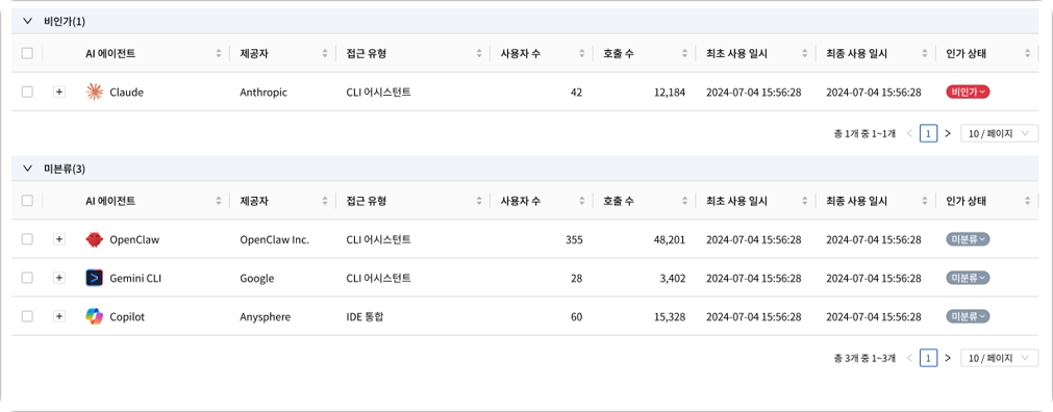
Identify AI agents, services, MCP servers, and other AI assets not approved by the organization.
Visualize AI assets in use and authorization status by department, user, and agent to manage misuse in real time.
GET STARTED
Start Generative AI More Securely,
with SOMANSA.
Frequently Asked Questions
Here are the most frequently asked questions before adopting Privacy-i AIDR.
This is the first question.
This is the answer to the first question.
This is the second question.
This is the answer to the second question.
This is the third question.
This is the answer to the third question.
